Mapping the Overlap Between Cloud Engineering and Data Engineering
Open a job board and you'll find two clean, separate listings. One wants a Cloud Engineer: someone who provisions infrastructure, manages networking and identity, and keeps cost low and uptime high. The other wants a Data Engineer: someone who builds pipelines, models data, and makes sure the numbers are trustworthy by the time they hit a dashboard.
The org chart treats these as different jobs, often on different teams, sometimes reporting into different parts of the business entirely. For a lot of what each role does, that separation makes sense.
But there's a growing band of work in the middle that doesn't belong cleanly to either title, and platforms built without someone owning that middle tend to show it. This usually means poor cost estimates and overspend, security gaps, or pipelines that quietly fail whenever a source system changes.
This article maps that overlap properly: what problem each discipline is actually solving, where the two intersect in practice, and what it takes to build people who can operate across both without pretending the two disciplines are the same thing.
Data engineering and cloud engineering solve different problems
Before getting into where they overlap, it's worth being precise about where they don't, because the distinction is the whole point.
Data engineering is focused on the end-to-end data lifecycle; from ingestion through to serving. As you progress into senior engineer and architect roles your focus switches to making sure your data platform is both scalable and cost efficient.
Clouding engineering differs by focusing on the underlying infrastructure that enables the data engineering work. Cloud engineers focus on security and access management, making sure the infrastructure scales, has appropriate monitoring and alerting, and making sure that CI/CD best practices are enforced to create reproducable environments.
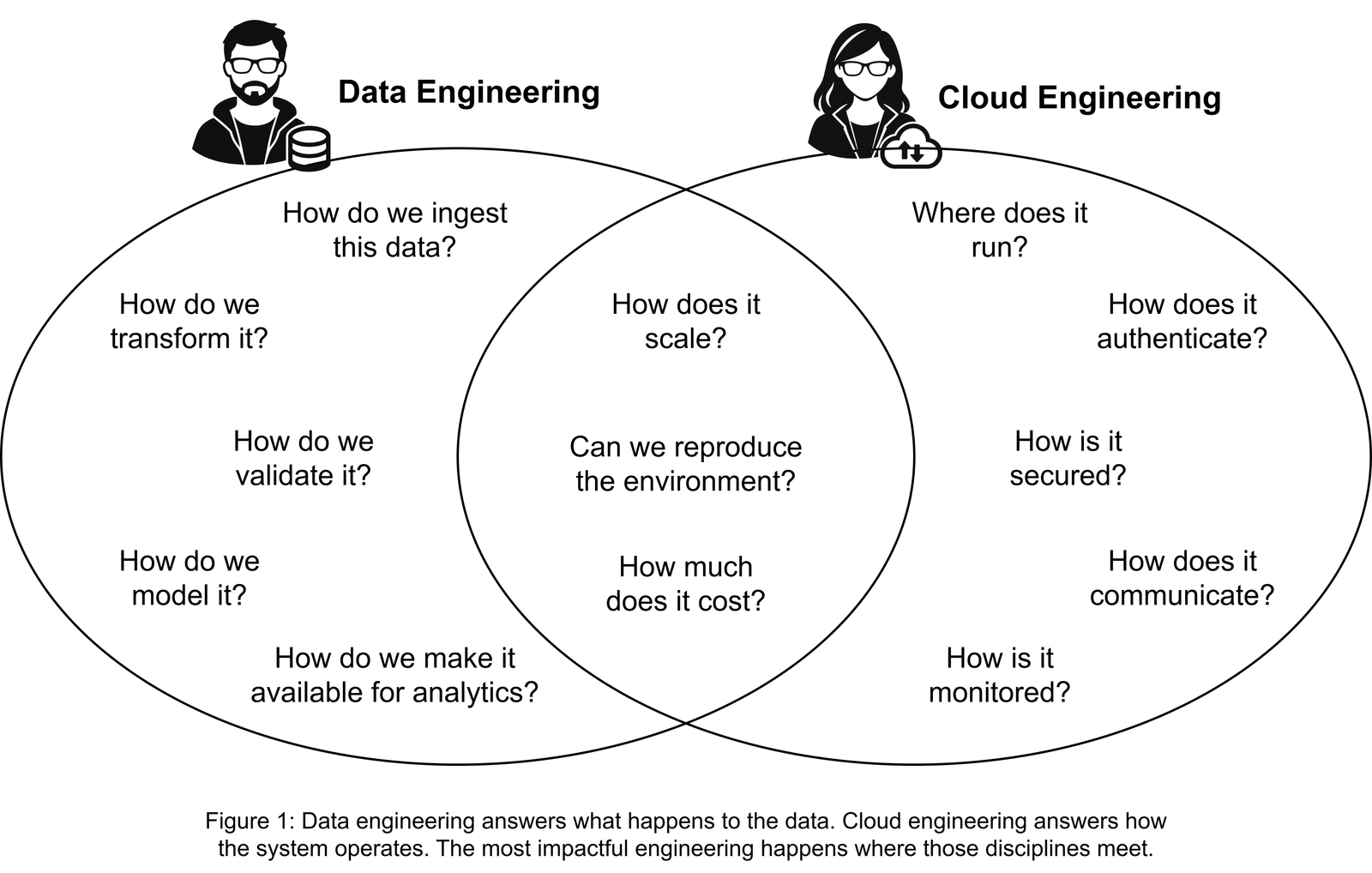
Neither discipline replaces the other. A data engineer who can't answer the cloud engineering questions isn't a lesser data engineer, they're working a different problem. The strongest data platforms need both the data and cloud components managed by people who understand how their answers constrain each other.
Where the two disciplines overlap
This is where it gets interesting, because the most expensive mistakes happen at the seams between these two disciplines, not inside either list on its own.
Identity and access
A data engineer typically understands the mechanics: service principals, managed identities, RBAC, Key Vault, storage permissions. That fundamental knowledge is not enough to make a pipeline authenticate successfully.
Cloud engineering asks the broader architectural question underneath it: who should be allowed to access what, from where, using which identity, and under what conditions.
The distinction shows up clearly in how the same symptom gets framed:
Data engineering problem: "My pipeline can't write to ADLS."
Cloud engineering problem: "Why does this workload have access to production storage in the first place?"
The first question gets a pipeline unblocked. The second question is the one that protects the platform.
Networking
This is one of the clearest places to demonstrate real expertise, because it's where "correct code" and "working system" diverge: VNets, private endpoints, DNS, firewalls, and network isolation are protocols that restrict unauthorized processes from running.
A pipeline can be written flawlessly and still fail, not because the logic is wrong but because the infrastructure won't let it reach its destination.
A data engineer can build the perfect pipeline. Cloud engineering determines whether that pipeline can actually communicate with the systems it needs.
Infrastructure as code and environments
Every data platform eventually runs into some version of "it works in development." Cloud engineering is what prevents that from being a permanent state. Using infrastructure as code (IaC), typically Terraform or Bicep, cloud engineers can create repeatable infrastructure, environment configuration, parameterization, proper Dev/Test/Prod separation, and automated deployments.
This is also where a real client pain point lives: consistency. If production is manually configured, production isn't really an environment, it's a collection of undocumented decisions. This will not stand up to an audit.
Security and governance
Too often teams say "security is important" but then just move on. The more useful framing is that governance needs to become part of the platform itself, not a checklist applied when someone remembers.
Data engineering owns data classification, retention, data quality, and lineage. These are all important and help prevent data leaks or wrong decisiong that can lead to lawsuits!
Cloud engineering owns role-based access control (RBAC), network boundaries, encryption, secrets management, policies, and resource configuration.
Combined properly, the two don't just produce secure pipelines, they produce a governed cloud environment (and data platform) rather than a collection of data pipelines that happen to move information around. For regulated-industry work, that distinction is the entire value proposition.
Observability and reliability
Data engineering tends to ask a narrow question: did the pipeline succeed? Cloud engineering broadens that considerably and needs much more granular observability to answer questions like:
- Did the compute service have capacity?
- Did networking fail somewhere upstream?
- Did authentication fail silently?
- Did cost suddenly spike?
This is the difference between pipeline observability and platform observability: a green pipeline doesn't necessarily mean a healthy data platform.
Performance and cost
This is where things move away from being strictly technical. Data engineers optimize SQL, Spark jobs, transformation logic, file formats, and strategies to partition data. Cloud engineers are working the same problem from the infrastructure side: compute sizing, networking costs, storage tiers, data movement patterns, and the architecture choices underneath all of it.
It's important to remember that performance and cost are architectural properties, not merely code-level problems. You can tune a query indefinitely and still be bleeding money on an architecture decision made two layers below it.
Deployment and operations
Eventually someone has to answer: who owns this platform after it's built? That's CI/CD, release pipelines, rollback strategy, configuration and secrets management, infrastructure deployment, versioning, and operational runbooks. Yes, that's a lot!
The broader argument underneath all seven of these areas is the same one: a production data platform is a product. It needs software engineering and cloud engineering practices applied to it, not just data modelling skill.
The Pi-shaped Cloud Native Data Engineer
None of this means data engineering and cloud engineering are interchangeable, or that a data engineer with a passing awareness of networking has "covered" the overlap. The model that actually holds up, and the one this article has been building toward, is pi-shaped: depth in data engineering, matched by real depth in cloud engineering, not just enough breadth to get by.
That's a bigger ask than the more common advice, which usually stops at "have some cloud awareness." Depth in data engineering means pipelines, SQL, data quality, modelling, orchestration, the ability to actually build and reason about the systems that move and shape data. Depth in cloud engineering means the same standard applied to networking, IAM, security, and architecture, not knowing the terms but being able to make and defend real decisions in each.
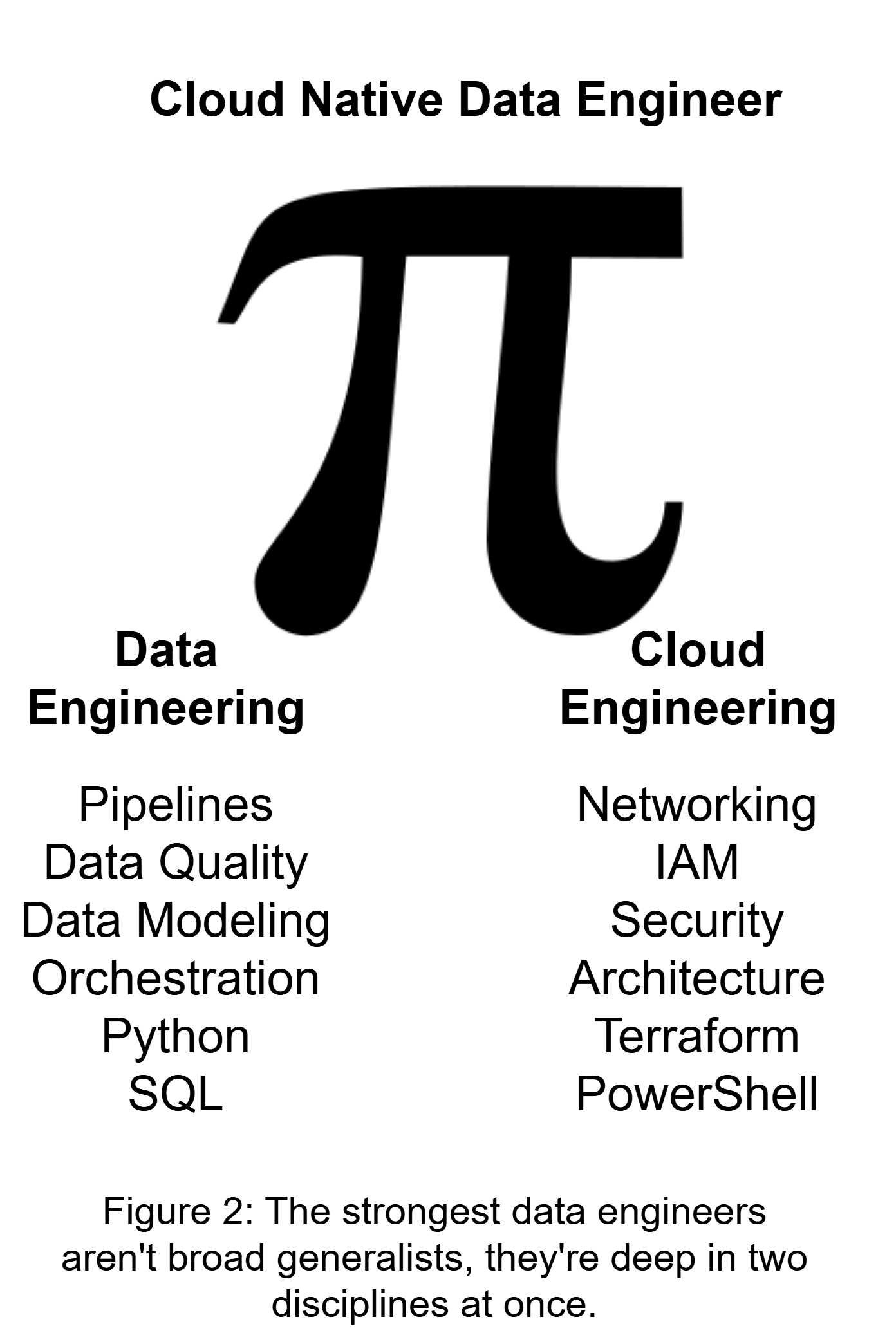
The reason this matters more than it might first appear: a lot of the failures described earlier in this article, don't get caught by someone who has surface familiarity with the other discipline. They get caught by someone who's actually done the work on both sides and recognizes the shape of the problem.
That's a harder standard to hire for and a harder one to become. But it's the difference between a data engineer who can ask a cloud engineer the right question, and one who doesn't need to ask at all.
What this means for you
If you're hiring or scoping a build, stop screening purely against the job title. Ask how a candidate would handle a modelling decision with a cost consequence, or a security constraint that reshapes a pipeline design. Those answers tell you more than years of experience against either title in isolation.
If you're a practitioner, the Pi-shape is the practical goal, understand cloud engineering and data engineering in depth. For data engineers, that usually means starting with identity and access and networking, since those are the two areas most likely to block a platform you've otherwise built well.
The interesting problems, and the expensive mistakes, live in the part neither job description quite covers.
I work across both sides of this line building data and AI platforms in Azure for regulated industries, including defence and aviation. If you're evaluating a build and want a second opinion on where things could be improved, feel free to get in touch.